How sprint handicaps work: reading the Ayr Gold Cup weights
Ratings, claims and an overflow race explain why the Gold Cup field looks the way it does.
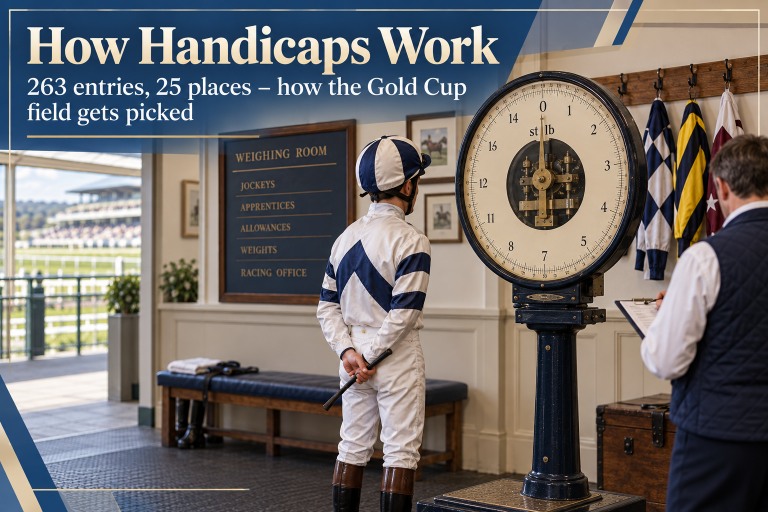
If you’re new to racing, a big field handicap like the Ayr Gold Cup can look chaotic. It isn’t. Higher-rated horses carry more weight, to level the field. Understanding that one rule makes the whole race far easier to follow.
What a handicap actually is
In a handicap, every horse is assigned an official BHA rating, a number reflecting how good it is. That rating decides how much weight the horse carries on the day. Better horses carry more weight, weaker horses carry less. In theory, this levels the field so any of them could win.
From rating to handicap mark
The official rating itself is called the horse’s handicap mark. BHA handicappers assess every run and adjust that mark up or down. A mark of 100 might mean carrying 9-7, while a mark of 85 could mean 8-6, with the exact scale set separately for each race.
The Ayr Gold Cup’s format
The Gold Cup is a Class 2 Heritage Handicap, capped at 25 runners, a status shaped by the race’s own history. Weights are set by the official BHA handicapper at the declaration stage.
What happens when too many horses want to run
This year 263 horses were entered for just 25 places. When entries outnumber the spots available, the field is trimmed by rating. Horses whose rating falls below the cut-off point, sometimes called the boundary, don’t get in. It doesn’t matter how many entries they held earlier.
The overflow race
Not every horse that misses the cut goes home empty-handed. The Ladbrokes Ayr Silver Cup runs immediately before the Gold Cup, over the same weights and distance. It gives horses just below the boundary a race of their own.
Why it matters for punters
Understanding the rating system explains why the same horse can look brilliant in one race and struggle in another. It’s rarely a change in ability, it’s the weight on its back changing to match.
Rating and weight are only part of the picture, though. On the day itself, three other factors decide the winner just as much: the draw, the pace of the race, and the state of the going. Our look at Ayr’s draw and pace trends covers the first two in depth.
Key takeaways
- A higher BHA rating means more weight, not more chances to win outright
- The rating itself is called the horse’s handicap mark, reassessed after every run
- Big heritage handicaps cap the field, so entries above the line don’t get in
- Draw, pace and going all matter once the weights are set