Jockey Club quits Racecourse Association as governance rift threatens to split British racing in two
Britain’s biggest racecourse group has followed Ascot out the door, and the industry now looks divided into two camps.
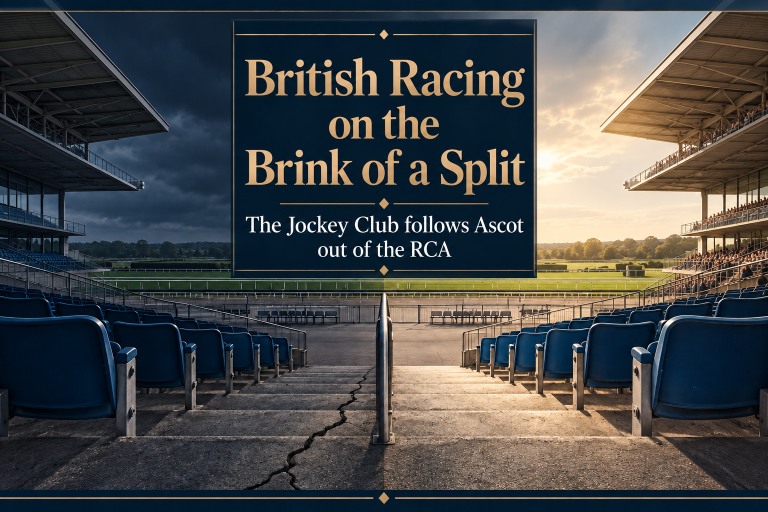
The Jockey Club, which owns 15 of Britain’s leading racecourses, has announced it will leave the Racecourse Association at the end of 2026. The move deepens a rift that already threatens to divide British racing into rival camps.
How it started
The crisis traces back to March, when Lord Allen resigned as BHA chair after just six months in the role. He had failed to secure the independent BHA board he had made a condition of taking the job.
Ascot, the Jockey Club and other large independents demanded urgent governance reform within weeks. Ascot left the RCA on 4 May, frustrated that its end-of-April deadline had passed without sufficient progress.
The RCA’s own governance review, launched in March, was extended to conclude on 31 July. It published its findings on 1 August, proposing the removal of the one-course-one-vote system and changes to how racecourses are represented on the BHA board.
The Jockey Club walks out
On Monday 3 August, the Jockey Club confirmed it would leave the RCA at year’s end. Chief executive Jim Mullen said the review had addressed the RCA’s internal arrangements. It had not, he said, addressed the constitutional question of how racecourses collectively exercise influence over the sport’s governance.
He argued the proposals failed to address a fundamental concern: that the RCA could still act to stifle changes the industry needs. The Jockey Club, he said, intends to build a new organisation together with Ascot and other like-minded industry partners.
A third track follows
Taunton became the third track to leave the RCA in mid-August, after Plumpton departed back in 2024. Taunton said the sport needs an empowered BHA, independent of vested conflicts of interest within the industry. It added it would be willing to return if a genuinely independent governance structure emerged.
Two camps forming, or maybe three
The shape of the split is becoming clearer, though not entirely settled. On one side sits a coalition of major tracks, the Jockey Club and Ascot among them. On the other is Arena Racing Company, which operates on a business model built around fixture volume for off-course betting rather than raceday quality.
Complicating the picture, Goodwood and York have put forward their own alternative. They propose stripping the RCA of its commercial representation role entirely, replacing it with three new BHA panels covering elite Flat racing, foundational Flat racing and jump racing.
A BHA spokesperson said the authority will continue to liaise with racecourses and other bodies on the sport’s governance structure, and will consider all proposals made. The organisation’s new chair, Simon Cox, takes up the role on 1 October, arriving in the middle of the dispute.
Part of a wider crisis
This governance rift is not happening in isolation. It follows Lord Allen’s resignation, last year’s Budget tax rises, the BHA’s #AxeTheRacingTax campaign and September 2025’s racing strike. All of these have strained relations with the Betting and Gaming Council.
Combined with the retail closures already reshaping bookmakers’ high street presence and a 2027 fixture list that trainers call sub-optimal, British racing is facing pressure on funding, fixture volume and governance all at once.